
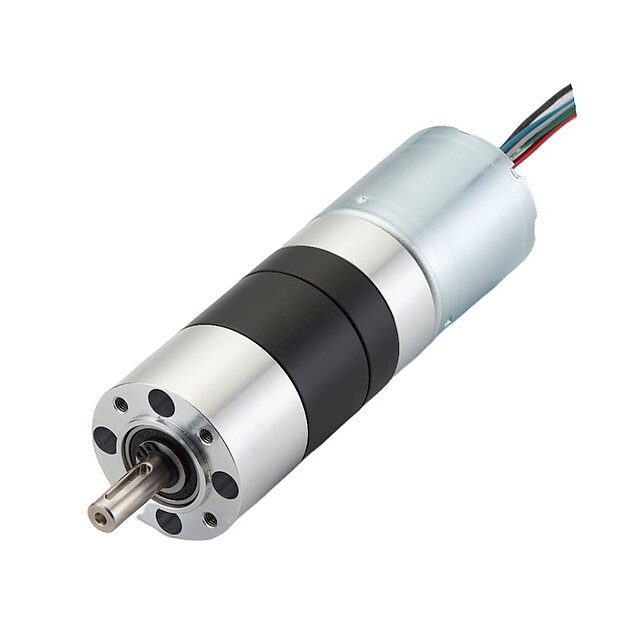
BLDC Motor with an Innovative Planetary Gear
The new P042066 series features a BLDC motor combined with a new planetary gear in two variants.
Both versions feature double ball bearings and reinforced planetary gears.
In the second variant, the first stage of the planetary gear has helical teeth and is made of plastic, which significantly reduces operating noise.
Advantages of this P042066 series BLDC planetary gear motor
- Low gear backlash
- Low noise in versions with plastic gears
- Short response time
- High torques and rotation speeds
- Low moment of inertia
- Lower power consumption
- High efficiency over a long lifespan
Technical specifications of the LN planetary gear
- Voltage: 24 VDC
- Rotation speed: 11 to 800 RPM
- Rated torque: 0.5 to 13.2 Nm
- Gear with two ball-bearings and reinforced planetary gears
- A variant with helical-toothed plastic gears in the first stage
Applications
- In high-precision applications that require minimal gear backlash, such as the positioning of laser optics, in mechanical processing devices, or in order-picking systems.
- The variant with plastic planetary gears is primarily used in noise-sensitive applications.
Why does a manufacturer need this BLDC planetary gear motor?
- An LN planetary gear is technically far superior to a conventional planetary gear in every respect. This is especially true when it is electronically controlled, as the data can be utilized much more precisely.
- An LN planetary gear largely avoids the weaknesses of a conventional planetary gear.
- With this planetary gear, the motor is longer overall (66 mm), which allows for higher rotation speeds. This results in improved rated power.
- If the motor’s diameter had been increased, torque would indeed have increased, but so would the breakaway torque. This would result in higher current draw and lower rotation speeds. In applications requiring higher rotation speeds, this would be a disadvantage.
- The reduced starting torque enables shorter response times, which is necessary in some designs—especially in electronically controlled BLDC motors with many varying requirements.
Differences between the LN planetary gear and conventional planetary gears
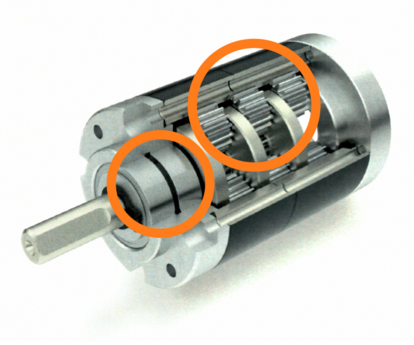
LN planetary gear with double ball bearings and reinforced planetary gears
Double Ball Bearing
- Better resistance to radial forces, e.g., from a mounted pulley.
- Protects the planetary gears from overload
- Significantly longer service life
- Higher power transmission possible
Reinforced planetary gears
- Improved force distribution due to wider contact surfaces
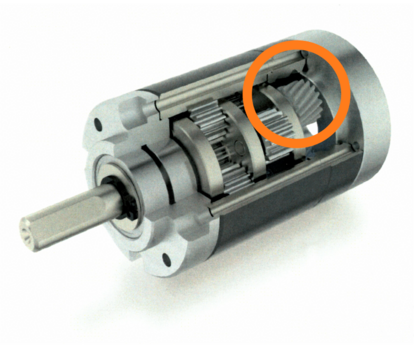
Plastic wheel in the first stage
- Helical-toothed planetary gears
- Engage in stages
- Smooth transfer of forces
- Reduced vibrations and shock loads
- Low noise
- Less wear
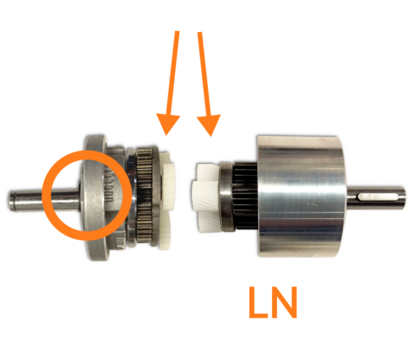
Comparison of a conventional planetary gear with an LN planetary gear
- On the left, a conventional planetary gear with a ball-bearing and narrower planetary gears
- On the right, the LN planetary gear with double ball-bearings and reinforced planetary gears (shown here is the version with helical-toothed plastic gears)
The motor product filter as a selection tool
Our customers like to use our online product filter to help them choose the right BLDC planetary gear motor.
Get a quick overview of the performance ranges of the P042066 series presented here, as well as other series of planetary gear motors. Conduct a comparison of multiple motor types based on their performance data.
Find the right BLDC planetary gear motor »
Product Filter
No match for the required drive component here?
Oh, then we have not yet included the right product for your requirement criteria in our online product database
But maybe in our warehouse after all!
We have almost countless types of DC motors and drive components on offer and many are even available in stock. Or we can assemble the complete drive system specifically for your application. We would be happy to work with you to consider which configuration might provide the optimal drive. Just talk to us directly!
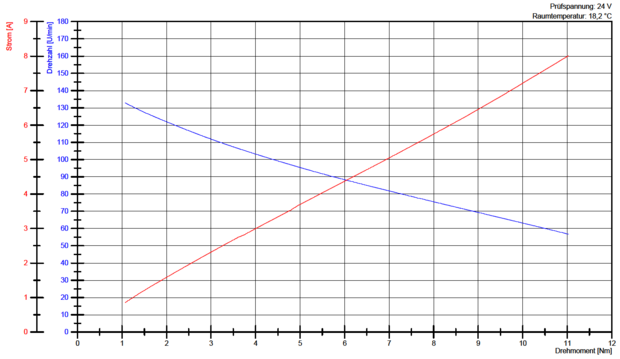
Performance curves for the P042066.0025.80 BLDC planetary gear motor
JBW provides you with performance curves for each planetary gear motor, which are determined as standard under load on our own drive test stand.
Upon request, we can simulate your application, taking into account the specific load parameters. This allows you to quickly see how this motor type will perform in your specific application.