What is a drone?
Drones or unmanned aerial vehicles (UAVs) are flying systems without human pilots on board. These aircrafts are fundamentally changing agriculture management, surveillance, delivery services, photography and many other areas. The latest drone technology makes them smarter, safer and applicable across almost all industries.
Drones are usually classified according to size, range and field of application. Some are small and compact, others are medium-sized. Their range varies from a few meters for small and compact drones to thousands of kilometers for large drones.
What would a drone be without propulsion technology?
One of the most important components of drones is their propulsion system: several rotors ensure stability and maneuverability and allow the drone to hover and move in different directions. The drone's control system uses cameras, GPS modules, radar, infrared sensors, inertial measurement units (IMUs) and sometimes also LIDAR for obstacle detection and precise navigation, as well as communication links for real-time data transmission.
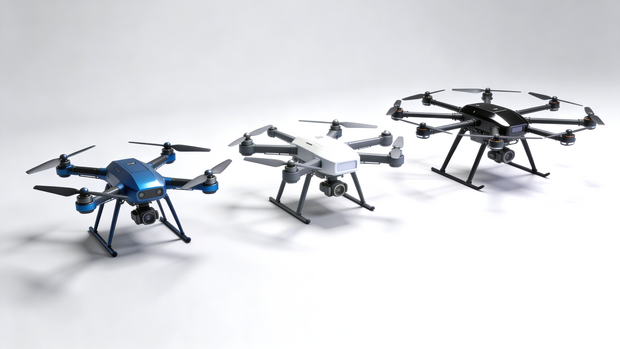
Categorization of drone types from a design perspective
Multicopter drones
Multicopter drones are quadcopters, hexacopters and octacopters. These consist of several symmetrically arranged rotors with propellers. They are highly efficient and can take off and land vertically. They are the most widely used type of drone. Quadcopter engines are specially designed for optimal thrust and stability, ensuring smooth flight and precise maneuverability. This type of drone is often used for aerial photography, surveillance and inspection as well as hobby applications.
Fixed-wing drones
These drones are similar to conventional airplanes with wings. They are efficient in flight and cover long distances. Fixed-wing drones are suitable for long-range mapping, agricultural pesticide application and defense surveillance. They are generally used for aerial mapping, surveillance and agriculture.
Single rotor drones
These drones consist of a single rotor and a tail rotor for better stability and control. They have a helicopter-like structure and are more efficient than multicopters for transporting heavier payloads. Single-rotor drones are less common in comparison to multi-rotor drones due to their high cost and complex design.
Hybrid VTOL drones
Hybrid VTOL drones combine the attributes of fixed-wing and multi-rotor drones. They are capable of vertical take-off and landing as well as efficient forward flight. They are suitable for aerial mapping, surveillance and cargo transportation.
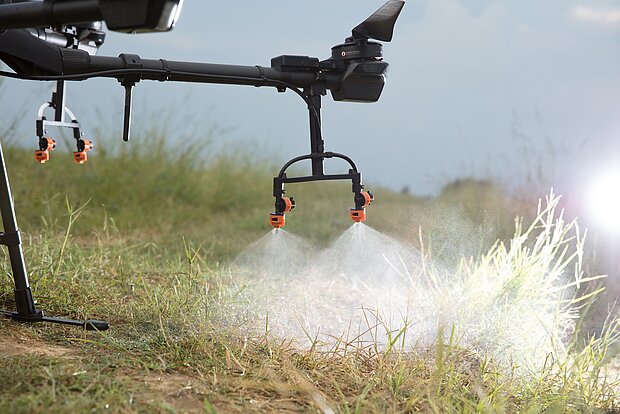
Categorization of drone types according to application-specific equipment
Photo drones
These drones are designed to take high-quality photos and videos. They are equipped with high-resolution cameras, GPS and functions such as autopilot and obstacle avoidance.
Brushless gimbal motors stabilize the camera and ensure smooth recordings even during dynamic flight movements.
Military drones
These drones are used by the military for surveillance, information gathering and defense. They come in various sizes and configurations, from small reconnaissance drones to large armed drones.
Agricultural drones
These drones are used in agriculture, for example for crop monitoring, pest control, crop protection and precision irrigation. This helps farmers to achieve higher yields and carry out higher quality agricultural work.
Brushless DC motors in these drones ensure reliable rated power, higher efficiency and the energy required for continuous agricultural use.
Mission drones for disaster control
Emergency drones are used by firefighters, police and civil protection forces to assess disaster situations and provide medical supplies and communications equipment.
These drones use high-torque gimbal motors to stabilize cameras and sensors, ensuring clear images and precise data capture in critical environments.

How does a drone work?
Motors and propellers generate lift and enable the drone to move by adjusting its speed. Rotor blade adjustment is not available and therefore the motor speed changes in multi-rotor drones in order to tilt, turn or hold a position. At the heart of the drone is a flight controller that uses data from various sensors such as gyroscopes, accelerometers and GPS to maintain balance and direction. The motor power is controlled by an electronic speed controller based on the flight controller's specifications.
When commands such as throttle, pitch, roll and yaw ang les are sent, a multicopter consistently performs the desired tasks. Lift is generated by the combined thrust of the rotors. Control is achieved via minimal changes in thrust. For pitch and roll, the motors are accelerated at the rear or on one side and braked at the front or on the other side. Yaw is generated by the rotor torque: motors turning in one direction are accelerated, while motors turning in the opposite direction are decelerated. This causes the aircraft to rotate around itself without losing altitude.
As simple as this functional principle may seem, a drone works just as precisely close to the ground, near buildings and in confined air spaces. They hover over rooftops, around towers and masts as well as above groups of people.
Drones are typically powered by lithium polymer (LiPo) batteries, which offer a good weight to energy capacity ratio. These batteries power the drone's motors, controller and other systems.
What fields of application are drones used for?
Industry and energy
- Plant inspection: oil and gas infrastructure, refineries, pipelines and industrial plants
- Wind energy: Inspection of rotor blades, hubs and towers
- Solar energy: thermal inspection of solar modules for fault detection
- Mining: mine planning, surveying, volume measurements, safety checks
Traffic and mobility
- Traffic monitoring: congestion analysis, construction site overview and incident management
- Maritime applications: Monitoring of coasts, rivers and shipping traffic, emergency assistance at sea
Infrastructure and construction
- Surveying and mapping: creation of site plans and elevation models
- Energy infrastructure: inspection of power lines, substations and wind turbines
- Telecommunications: inspection and partial support of mobile phone and transmission masts
- Land use and urban planning: analysis of areas, buildings and infrastructure
- Bridge, road and tunnel inspection: faster visual inspection with less risk to people
- Building inspection: inspection of roofs, facades, scaffolding and hard-to-reach areas
- Construction progress: measurement of construction sites, volume calculation, target/actual comparison
Agriculture and forestry
- Plant monitoring: early detection of stress, diseases and nutrient deficiencies
- Precision spraying: Targeted use of water, fertilizer or pesticides
- Irrigation management: detecting drought stress and optimizing water distribution
- Animal and pasture management: monitoring livestock, fencing and pasture areas
- Forestry: forest condition, reforestation, pest and fire monitoring
Environment and nature
- Environmental monitoring: air quality, erosion, water bodies, coasts and protected areas
- Wildlife monitoring: counts and observations without disturbing the animals
- Nature and climate research: measurements, sampling and long-term observations
Aerial photography, photography and media
- Aerial photography and videography: for filming, advertising, events, tourism and real estate
- Content production: social media visuals, drone shots for documentaries and TV
- Photogrammetry for media projects: 3D visualizations, virtual tours and digital twins
- Aerial and light shows: "drone ballet"
Rescue and public safety
- Search and rescue services: searching for missing persons, including with thermal imaging cameras
- Disaster control: situation reports after floods, earthquakes, storms, fires
- Fire department: investigation of sources of fire, embers and danger zones
- Police: situation monitoring, crime scene documentation and coordination of operations
Logistics and delivery
- Parcel and delivery services: last mile, express deliveries
- Medical care: Transportation of blood, samples, medication, emergency supplies
- Warehouse and supply chain monitoring: inventory control and operational support in large areas.
Military and security
- Reconnaissance and surveillance: observation, target acquisition and situation analysis
- Target drones: As training and target systems in training
- Armed systems: Also used for combat operations in some armed forces
Research and technology
- Testing sensor technology and autonomy: navigation, obstacle detection and AI-supported flight control
- Airborne data acquisition: thermal, multispectral data, 3D scanning and inspection data
- Development of innovative unmanned aerial vehicles
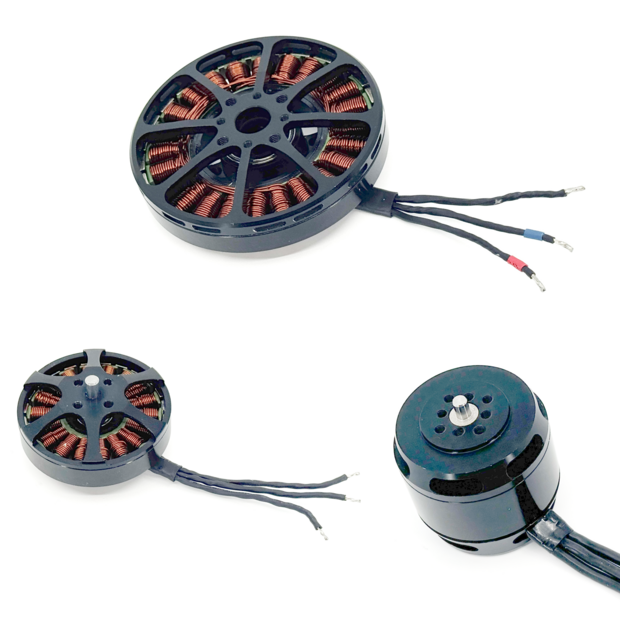
Parameters for the right motorization
- KV value (rpm per Voltage)
The KV value indicates how many revolutions per minute a brushless DC motor (BLDC motor) rotates per Voltage without load.
Motors with a high KV value:
Motors with a high KV value (e.g. 1000 KV to 2500 KV) rotate faster and are ideal for racing drones where speed is a priority. 1000 KV to 2500 KV) rotate faster and are ideal for racing drones where speed is a priority.
Low KV motors:
Low KV motors (e.g. 400 to 800 KV) rotate slower but offer higher torque. This makes them ideal for heavy-duty drones with high payloads. - Thrust (g or kg)
Thrust is the upward force that the drone motor can generate with a given propeller. For a stable flight, the thrust of the motor must exceed the weight of the drone. For smooth maneuvering and optimal payload support, a thrust-to-weight ratio of 2:1 is usually recommended. - Voltage (V)
Voltage is the electrical potential (current) supplied from the battery to the drone motor. It determines how quickly and efficiently a motor can operate. Each drone motor has a recommended voltage (7.4 V to 22.2 V), which must match the battery type of the drone. - Power (W)
The power of a drone motor is the amount of electrical energy that is converted into mechanical power and is measured in watts (W). Calculation: Power = voltage × amperage
High-power motors:
They provide more thrust and support large propellers, making them ideal for heavy-duty drones.
Low-power motors:
They consume less energy and are suitable for light drones with long flight times.
Meet JBW!
Check our news to see if you can meet us at a trade fair such as SPS in Nuremberg or SPS Italia in Parma in the near future. Bring the specifics of your application with you. We will find the right solution together.
Alternatively, simply give us a call and we can meet online or in person to discuss your application in detail.


Please let us know how such exemplary applications help you and which other applications for electric drive technology you would like to see explained on our website. You can either contact us by phone or email or you can also post your comments on our JBW company profile on Google*).
*) You must be logged into Google to use the QR code or the link to go directly to the input field in our company profile on Google. We welcome every friendly review, but we also understand anyone who does not want to comment publicly.